
What does a workplace safety audit include?
A workplace safety audit is an independent, systematic evaluation of site conditions, work practices, and written programs against the standards that govern your work — 29 CFR 1926 for construction, 29 CFR 1910 for general industry, 8 CCR 3203 and the rest of Cal/OSHA Title 8 in California. It ends in a photo-documented report with findings ranked by risk.
This is not a checklist walk. We evaluate how your policies, field conditions, and day-to-day practices actually line up — with federal and state regulations, and with the owner and contract requirements that often go further. For many clients it doubles as an OSHA compliance audit run before the real one: a mock inspection, conducted by people who know exactly where inspectors look.
Construction and manufacturing audits
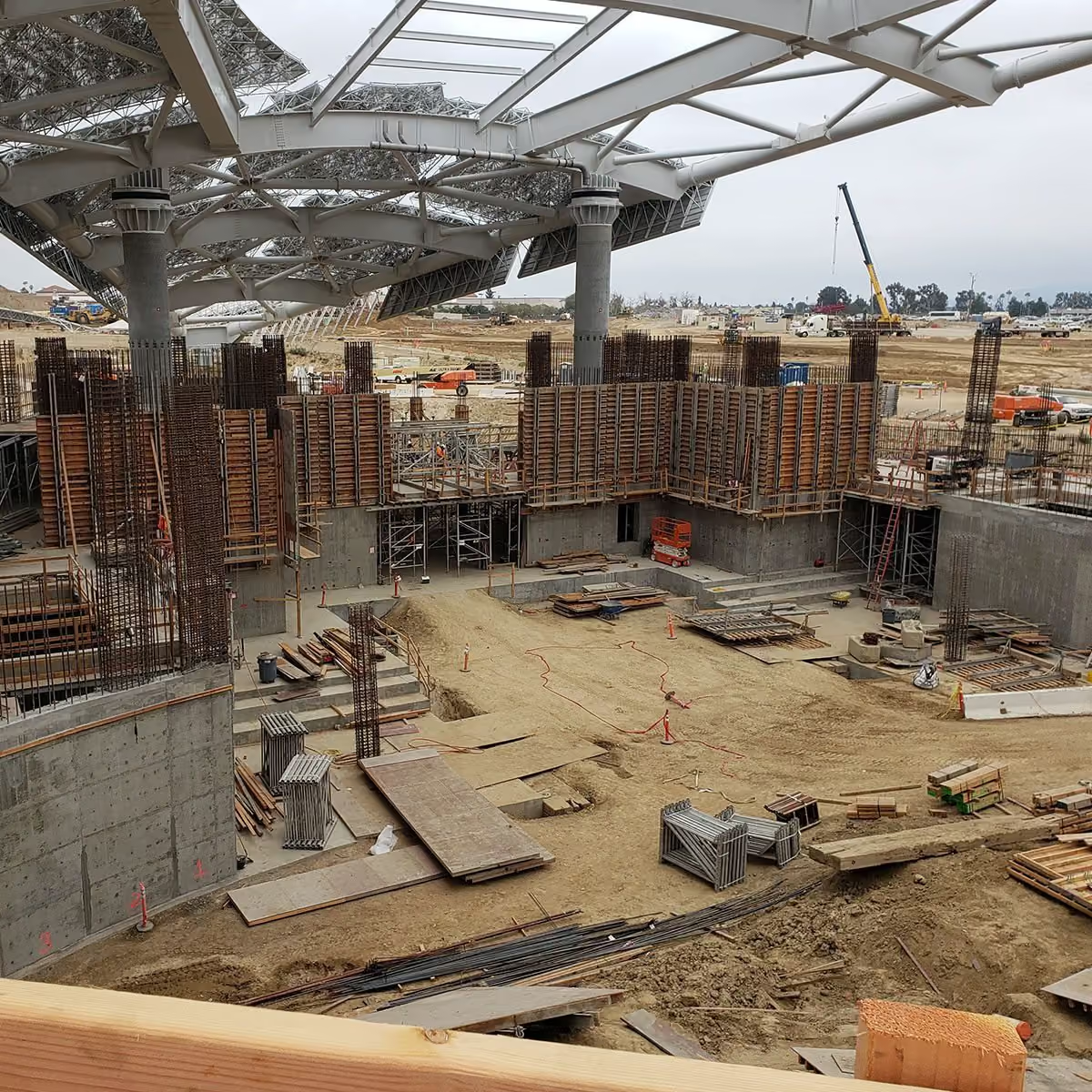
On construction sites we go deep on the hazards that drive citations — fall protection under 29 CFR 1926.501, scaffolding, excavation and trenching, crane and rigging operations, work zone traffic control — plus competent person designations and the training records behind them. In manufacturing, the focus shifts to machine guarding, production-line safety, ergonomic risk factors, and energy control under 29 CFR 1910.147. Both environments get the full sweep: hazard communication and SDS access, electrical safety and GFCI use, PPE and respiratory protection, confined spaces, hot work, and emergency preparedness. When energy-control findings trace back to people rather than procedures, our lockout/tagout training closes the loop.
Laboratory safety audits
Laboratories concentrate chemical, biological, and physical hazards next to people, equipment, and sensitive research. We audit against the OSHA Laboratory Standard, 29 CFR 1910.1450 — chemical hygiene plan alignment, labeling and storage compatibility, fume hood and biosafety cabinet condition and use, biosafety-level practices, sharps handling, eyewash and safety shower access, and SOP and training documentation. Academic, government, biotech, pharmaceutical, healthcare, and commercial testing labs — each audit is adapted to the research profile and the oversight structure it answers to.
Industrial facility safety inspections
For manufacturing plants, warehouses, distribution centers, cold storage, and utilities, a facility safety inspection covers powered industrial trucks under 29 CFR 1910.178 — operator authorization, pedestrian separation, racking integrity, loading dock safety — alongside machine guarding, chemical handling, job hazard analyses, OSHA 300 logs, and written program effectiveness. Higher-risk operations can add targeted assessments: noise exposure, ergonomics, respiratory protection program review, and confined space program evaluation.
How the audit process works
- Pre-audit planning — scope, schedule, operational constraints, and specific risk concerns, aligned before anyone mobilizes
- On-site assessment — a systematic walkthrough supported by observations, employee interviews, and document review
- Findings and recommendations — photo-documented, prioritized by severity, likelihood, and operational impact, with regulatory references and practical corrective actions
- Delivery in your software — PS&M’s platform or yours, including Procore and CMiC, so tracking, assignment, and closure happen where your team already works
- Follow-up support — optional re-audits, coaching, and implementation help until corrective actions stick
After the audit
An audit tells you where you stand. What happens next determines what it was worth. When findings point to program gaps, our OSHA compliance program development rebuilds the written foundation. When they point to coverage gaps, an embedded on-site safety professional keeps field conditions from sliding back. Either way, the report you hold is documented, dated, and defensible.